Advisory firms co-source on TaxTime with their clients. Audit firms work at audit clients where independence allows. Either way the client owns the platform and the data, and your people get a login on request.
You advise. The client runs its tax function on TaxTime, and your team works in their workspace: the same Tax Ledger, the same workpapers, the same review points. The evidence you need is already attached to the number, so the work starts from a position instead of a data request.
Independence rules are yours to apply, and you know them better than we do. Where the firm can prepare the return but not the provision, the client prepares and reviews in TaxTime, your tax return team works from the signed-off Tax Ledger, and your audit team reads.
The people with the upstream data do the preparation, in their own workspace. Your team spends its time where its market and technical experience counts: the review. No query lists, no review lists, no drafting rounds by email.

An information request list goes out by email. Trial balances, registers and GL extracts come back in pieces, over weeks.
The firm re-keys the data into its own workbooks, and the client does not see the workings until the draft arrives.
A late journal means a second data request and a second draft.
Every year starts from the firm's template, not from the client's last period.
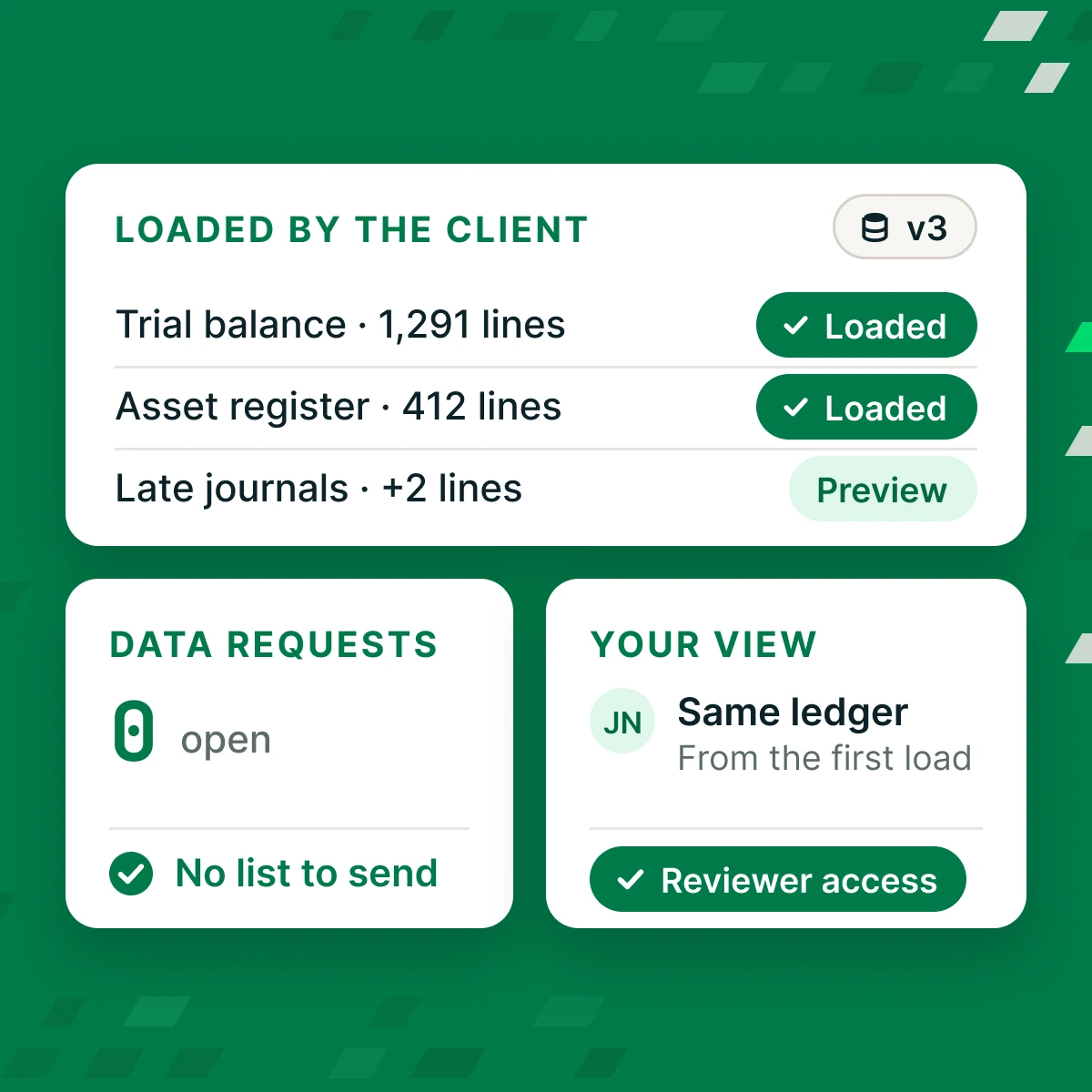
The client loads the GL and the registers itself, with a change preview, into its own workspace.
Rules apply the routine adjustments at GL level, so the in-house preparer starts from a calculated position.
A late journal is a re-load that previews what changed. Nothing is re-keyed.
Your team sees the same Tax Ledger from the first load, not at the draft stage.
What changes: the data request list disappears, because the people who have the data are the ones using it.

The reviewer's questions become a query list in Word or Excel, sent by email. Answers come back in a thread, days later.
The reviewer re-performs the maths because the workbook cannot be trusted at a glance.
Comparing to last year means two files open and a bridge rebuilt by hand.
The email thread becomes the record of what was reviewed, and nobody can find it in March.
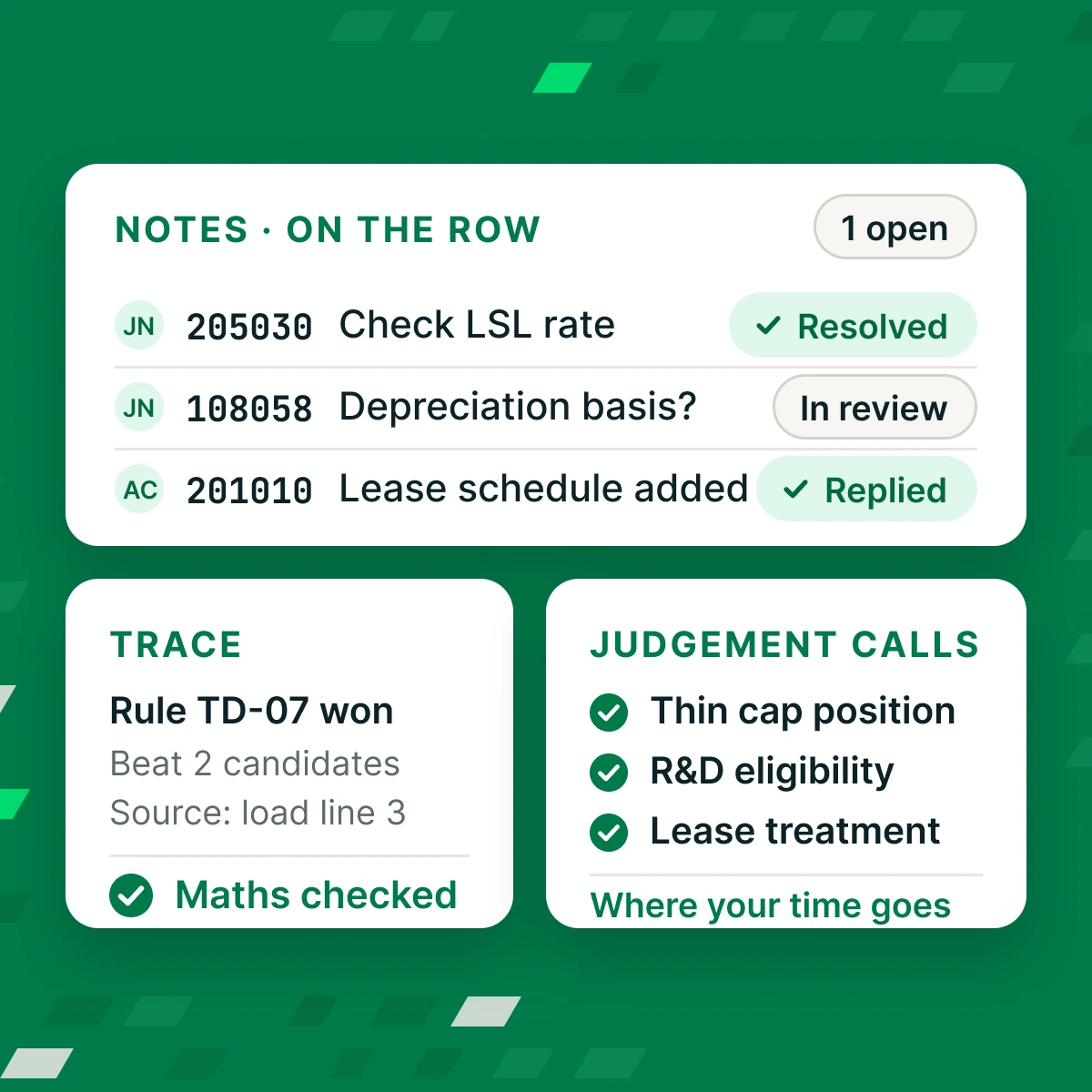
Review notes sit on the row they are about, with who raised them and when. The client is notified and resolves them in the same place.
Click any figure to see the rule that won, the candidates it beat and the source line behind it. The arithmetic is already checked.
Compare projects shows the movement against last period, line by line.
Your time goes on the judgement calls: the position on a transaction, the treatment that needs market experience, the risk worth a note to the board.
What changes: no query list, no review list, no drafting round. The review happens in the file.

The firm's workbooks hold the client's numbers, so every change in the year comes back through the firm.
Sign-off rests on a memo and a covering email.
For audit clients, the line between preparing and reviewing is hard to evidence.
When the engagement changes hands, the history goes with the firm.
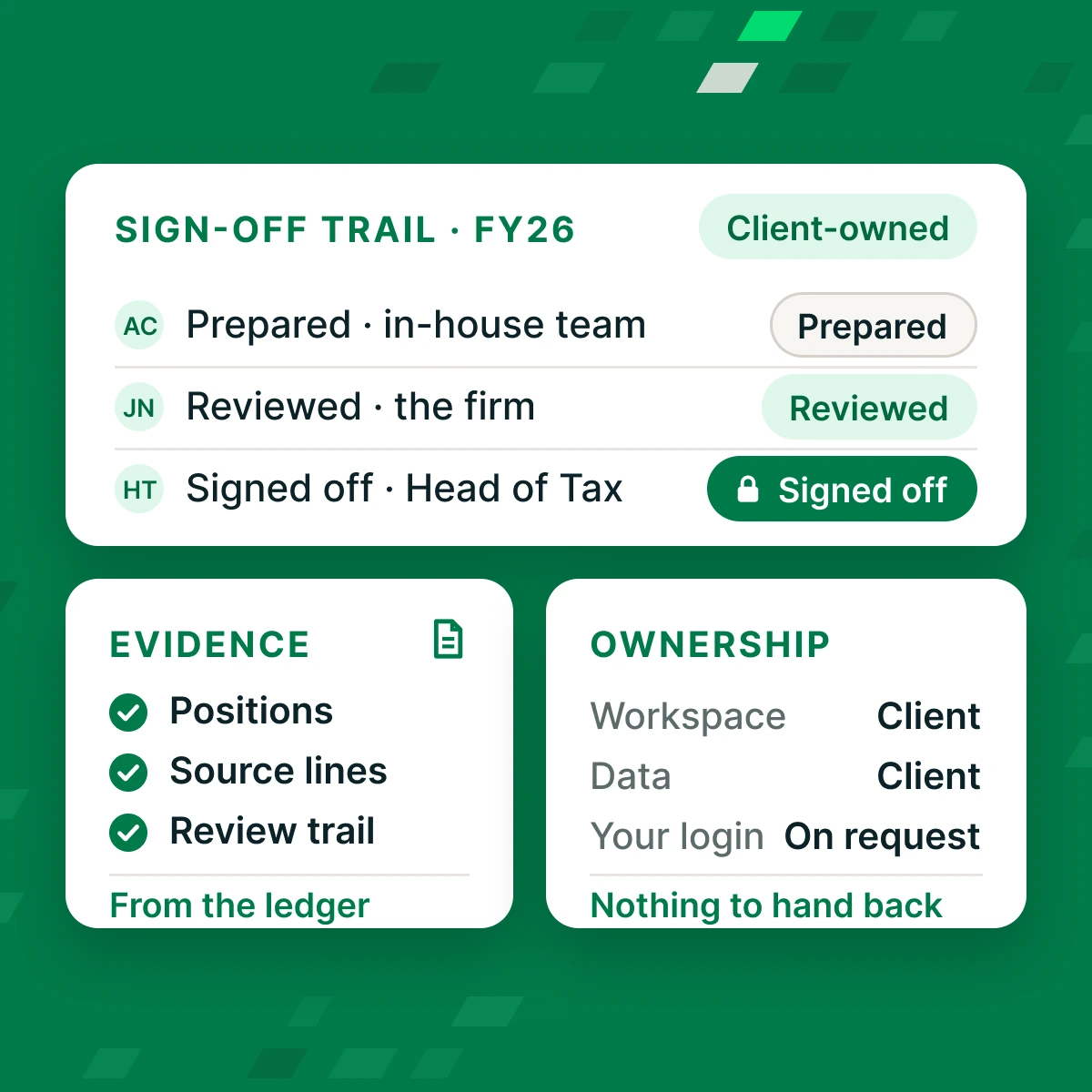
The client prepares and reviews in its workspace. Your reviewer marks it Reviewed, and the audit trail shows who did what and when.
Positions and evidence print from the same Tax Ledger in the Head of Tax pack and the ATO Evidence Pack.
For audit clients, the trail shows management's preparation and your review as separate acts, which is what independence needs to see.
The platform, the data and the history stay with the client. Your engagement is the advice and the assurance.
What changes: the relationship rests on your judgement, not on holding the file.
An adviser or auditor gets a login when the client asks. No contract change, no per-seat fee, no waiting for a renewal.
You work on the Tax Ledger the client signs off, with version history across workpapers, settings and reports. Nothing is emailed around and nothing drifts.
Comments and information requests sit on the GL account or workpaper row they are about, with who raised them and when.
Click a number to see how it was determined: the rule that won, the candidates it beat, and the source line behind it.
The ATO Evidence Pack and the Head of Tax pack print from the Tax Ledger that computed them, positions and evidence attached.
The platform and the data belong to the client. When the engagement ends, nothing has to be handed back and nothing is locked in a firm’s tool.
Read: Dependency Is Not AdviceAuditors test the controls first. In TaxTime they run inside the platform, the same way on every entity and every period, and each one leaves evidence in the trail. Once the controls hold, every figure in the Tax Ledger traces through its rule to the GL line it came from.

Roles decide who can prepare, review and approve. The trail records who did each, what they changed and when, so the control can be tested, not just described.
Opening plus movements equals closing before a load commits. The trial balance nets to nil. Unmapped accounts are flagged, not buried.
Disclosure to Tax Ledger row to rule to GL account to load line, on any number, during the meeting.
A firm never has to advocate for TaxTime. If a client of yours would benefit, tell us and we make the approach ourselves, so your independence and your relationship stay intact.
Start with a 30-minute call with Andrew or Jim about how your close runs today.